There’s a moment every seasoned architect remembers — the first time a certification completely failed you in the real world. Mine came about three years into my career when I walked into an executive briefing armed with a freshly minted certification, a technically flawless architecture proposal, and the confident energy of someone who had just finished the hardest exam of their life. I had the right answer. I had the diagrams. I had the acronyms.
I left that room with nothing approved, a skeptical CIO, and a lesson that no amount of study material had ever warned me about: knowing the right answer is only half the battle. The other half is getting people to care about it.
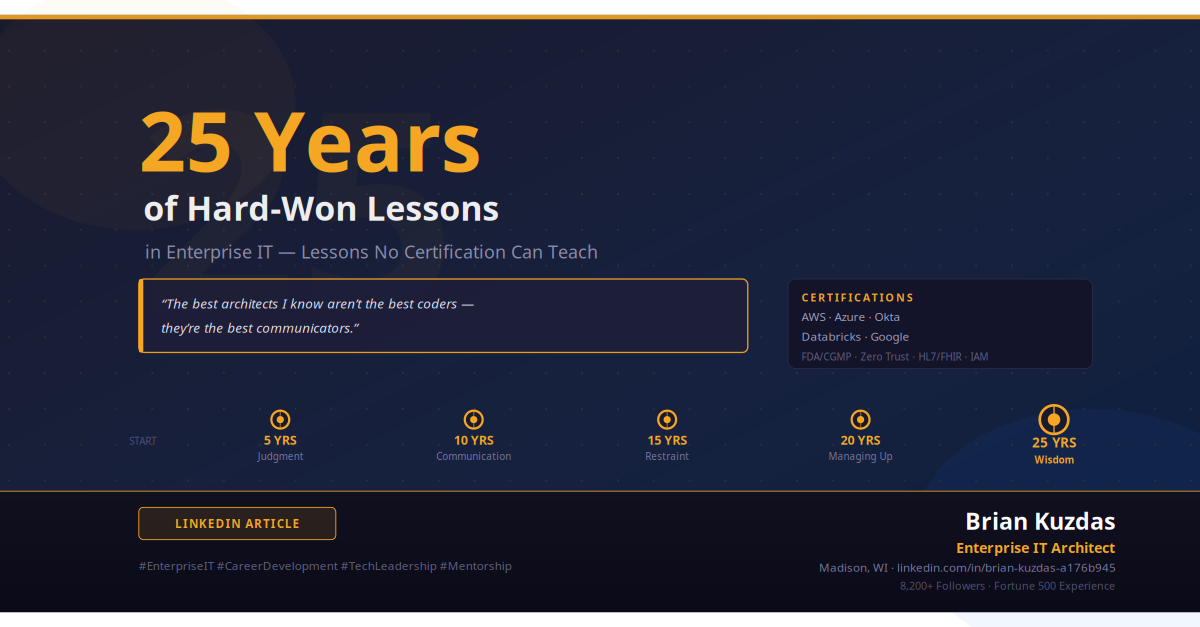
Twenty-five years later — having worked across Fortune 500 environments in healthcare IT, financial services, manufacturing, and pharma — I hold certifications from AWS, Azure, Okta, Databricks, and Google. I am genuinely proud of each one. They represent discipline, continuous learning, and a commitment to staying relevant in a field that reinvents itself every five years.
But the things that actually made me effective? Those came from failed projects, difficult conversations, political landmines, and hard-won trust built one relationship at a time. Here are six lessons that no certification program will ever teach you — but that will define your career more than any exam score ever could.
1. Certifications Teach Theory. Experience Teaches Judgment.
The gap between “knowing” and “doing” is wider than most early-career professionals expect — and narrower than most senior professionals admit.
Certifications are excellent at teaching what the technology does and, sometimes, how to use it. AWS Solutions Architect will teach you when to use S3 vs. EFS, the tradeoffs between RDS and DynamoDB, and how to architect a multi-region active-active deployment. That knowledge is real and valuable. But no certification will teach you that your organization’s data governance policy means you cannot put certain PHI into S3 buckets with default settings, or that the DBA team has a political alliance with the storage vendor and will resist any transition to managed cloud databases regardless of cost savings.
Judgment — genuine professional judgment — is the ability to weigh technical correctness against organizational reality, and arrive at a solution that will actually get built, secured, and maintained. According to CompTIA’s State of the Tech Workforce report, while 82% of employers value certifications as hiring criteria, the most common complaint about early-career hires is a gap between technical knowledge and applied problem-solving in ambiguous, politically complex environments.
I have watched brilliant certified engineers propose architecturally perfect solutions that died in committee because they never accounted for who owned the budget, who felt threatened by the change, and what legacy system the CISO built their career on fifteen years ago. The certification was not the problem. The missing ingredient was judgment — the kind that only accumulates through experience, failure, and reflection.
The practical implication: treat every project as a curriculum. Keep a private retrospective log. After every initiative — successful or not — write down what the theory said would happen and what actually happened. Over time, that gap becomes your most valuable professional asset.
2. The Real Skill Is Communication, Not Code
I made my biggest career leap not when I earned a new certification or learned a new framework, but when I stopped trying to explain technology and started translating consequences.
There is a profound difference between saying “we need to implement a zero trust network architecture with microsegmentation, identity-based access controls, and continuous authorization” and saying “right now, if one vendor laptop gets compromised, an attacker could move laterally to every system in this building. Zero trust stops that lateral movement at the door.” Same concept. Completely different impact.
Harvard Business Review has documented extensively that the most effective technology leaders spend 60–70% of their communication time translating between technical and business domains. The technical work is a given — it is table stakes. What separates architects who drive organizational change from those who produce excellent but unimplemented documents is the ability to make decision-makers feel the risk, opportunity, or consequence in terms they care about.
In FDA/CGMP validated environments, I learned this lesson with particular intensity. Regulators and quality leadership do not care about your architecture diagram’s elegance. They care about whether a system failure could compromise patient safety data, whether an audit trail is tamper-evident, and whether you can demonstrate control under 21 CFR Part 11. Translating a complex identity and access management strategy into those terms — patient safety, audit integrity, regulatory risk — is what moves projects from proposal to approval.
The skill is learnable. Practice it deliberately. Before every executive presentation, ask yourself: what does this person lose sleep over? Start there. Make the first slide about their problem, not your solution. The technical content can follow, but only once you have earned their attention by speaking their language.
3. Knowing When NOT to Build
This is perhaps the hardest lesson for technically talented people, because our entire professional identity is built around solving problems. The instinct to architect a solution — to build, integrate, automate — is deeply wired into engineers and architects alike.
But some of the best decisions I made over 25 years were about restraint.
Early in my career, I would have built a custom integration layer for almost anything. By year ten, I learned to ask harder questions first: Is there a SaaS product that does 80% of this? What is the total cost of ownership of custom code versus a maintained vendor product? Who will own this when I leave? Does this core capability need to be our competitive differentiator, or is it infrastructure that a vendor can maintain better than us?
Gartner’s research on enterprise architecture consistently identifies “unnecessary complexity” as one of the top contributors to technical debt and organizational drag. In a 2023 Gartner survey of enterprise architecture leaders, over 67% reported that their organizations carried significant “zombie applications” — custom-built tools that had outlived their original purpose but could not be decommissioned because institutional knowledge of their function had been lost.
In FDA-regulated environments specifically, this lesson cuts even deeper. Every custom-built system requires a validation plan, IQ/OQ/PQ documentation, change control, and ongoing maintenance burden. The decision to build custom versus configure commercial creates compliance obligations that compound over years. I have seen organizations spend more on validation documentation for an in-house-built reporting tool than the entire cost of a validated commercial alternative would have been.
The discipline of restraint — learning to say “we should not build this” — is a mark of architectural maturity. It requires ego management, because it means consciously choosing to not demonstrate technical capability. But it is almost always the right call.
4. Managing Up Is a Skill — And It Can Be Learned
Most technical professionals receive zero formal training in how to advocate for architecture and security priorities with senior leadership. We are trained to solve technical problems, not to navigate organizational politics, build coalitions, or frame technical risk in terms of business consequence.
This gap is costly. A 2022 Robert Half Technology survey found that 54% of IT leaders reported that security and architecture proposals were regularly delayed or rejected not due to technical merit, but due to poor stakeholder alignment and communication. The technology was sound. The advocacy was not.
Managing up effectively is not about politics in the pejorative sense — it is about understanding that your leaders have constraints, incentives, and pressures that you are not always fully aware of. The CIO who keeps pushing back on your zero trust proposal may be facing a board that has mandated a 15% IT cost reduction by year-end. The CISO who seems resistant to your identity platform consolidation may be managing a prior incident that the organization is still recovering from politically.
Effective upward management means doing the homework: understanding budget cycles, regulatory reporting timelines, organizational priorities, and the personal career incentives of key decision-makers. It means framing your security architecture proposal as “here is how this directly supports your Q3 compliance certification” rather than “here is why our current architecture is inadequate.”
It also means building allies before you need them. The relationships I cultivated with finance, operations, legal, and clinical leadership over the years — outside of any specific project — are what made my most important security initiatives successful. When a project needs cross-functional support, the time to build those relationships is not the day you need a signature.
5. Security Is About People, Not Tools
After 25 years, I have watched organizations spend millions on the most sophisticated security tooling available — next-generation firewalls, endpoint detection and response platforms, privileged access management, zero trust network access — and still suffer breaches because someone clicked a phishing link or shared credentials over Slack.
The cybersecurity industry has a technology fixation problem. We default to purchasing and deploying tools when the actual attack surface is overwhelmingly human.
According to Verizon’s Data Breach Investigations Report, over 74% of breaches involve a human element — phishing, credential misuse, social engineering, or error. IBM’s Cost of a Data Breach report consistently identifies social engineering and compromised credentials as the top initial attack vectors. The tools exist to detect and respond to these vectors. But no SIEM catches a user who willingly handed over their password to someone who called claiming to be from IT.
This is not an argument against security tools — it is an argument for proportion. The most important security investments I have seen organizations make were in culture and behavior: security awareness programs that were engaging and scenario-based rather than compliance checkboxes; helpdesk workflows that rewarded users for reporting suspicious emails rather than making them feel foolish; executive sponsorship of security culture that sent a clear message that security was everyone’s job.
In HL7/FHIR healthcare environments, the human factor is existential. The nurse who shares a patient portal login with a colleague because the provisioning process is too slow is not a bad actor — she is a human being solving a workflow problem with the tools available to her. The architect who designs that workflow without understanding clinical time pressure will build a technically compliant system that people route around at every opportunity.
Security architecture that ignores the human being in the loop is incomplete architecture. The best security systems I have designed were shaped by extensive conversations with the people who would use them — understanding their workflows, their pressures, and what would make compliance the path of least resistance rather than an obstacle.
6. The Projects That Failed Taught Me More Than the Ones That Succeeded
I do not have a polished, sanitized career narrative. I have a career full of things that went wrong — projects that ran over budget, integrations that broke in production, security architectures that seemed airtight until a novel attack vector exposed a gap, and stakeholder relationships that collapsed under the weight of a missed deadline.
Every one of those failures was a graduate-level education.
IEEE research on software project failure consistently estimates that between 50% and 70% of large IT projects fail to deliver on their original scope, timeline, or budget. The Standish Group’s Chaos Report has tracked these statistics for decades, with large enterprise projects having some of the lowest success rates. This is not a reason for despair — it is a reality that experienced architects internalize and plan around.
The specific failure mode I learned the most from was the silent assumption. Early in my career, I assumed that because I had documented something in an architecture decision record, the downstream teams had read and understood it. I assumed that because a security requirement was in the project charter, the development team had it in their sprint backlog. I assumed that because we had tested the integration in a QA environment, it would behave identically in production.
Every one of those assumptions, at some point, was wrong.
The lesson was not to become paranoid or to micromanage. The lesson was to build verification into communication: follow-up emails that summarize verbal decisions, architecture review checkpoints at implementation milestones, explicit “did you receive and understand this?” confirmation loops that feel redundant until the moment they catch a critical misalignment.
Failing forward — treating failure as data rather than verdict — is not just a mindset platitude. It is a professional survival skill in enterprise IT. The architects who last 25 years are not the ones who never failed. They are the ones who failed, learned specifically, and built that learning into their next project.
The Bottom Line
Twenty-five years in enterprise IT across Fortune 500 organizations, FDA-regulated environments, financial services, and healthcare has given me a perspective that no certification curriculum could fully capture. Here are the takeaways I would hand to my younger self:
Get the certifications — but know what they are. AWS, Azure, Okta, Databricks — each certification represents a body of knowledge that accelerates your ramp-up on a technology domain. Pursue them. But hold them lightly. They are a starting point, not a destination.
Invest in communication as a technical skill. The ability to translate complexity for non-technical audiences is not a soft skill — it is the skill that determines whether your technically correct work ever gets funded, approved, or built. Treat it like a discipline and practice it deliberately.
Develop the discipline of restraint. The instinct to build is powerful and often counterproductive. Some of your best architectural decisions will be “don’t build this.” Honor those decisions.
Build relationships outside IT before you need them. Finance, legal, operations, clinical — these are your future coalition partners. Invest in those relationships in the absence of any specific agenda.
Design security systems around human behavior, not against it. Compliance that requires heroic effort from users will be routed around. Design the secure path to be the easy path.
Keep a failure log. Seriously. Write down what went wrong, what you assumed, and what you would do differently. Review it annually. It is the most honest professional development tool you will ever use.
The certifications will get you in the room. The judgment, communication, relationships, and resilience will determine what you accomplish once you are there.
References
-
CompTIA. (2023). State of the Tech Workforce 2023. CompTIA Research and Market Intelligence. https://www.comptia.org/content/research/state-of-the-tech-workforce
-
Robert Half Technology. (2022). IT Hiring and Salary Guide. Robert Half International. https://www.roberthalf.com/us/en/insights/salary-guide/technology
-
Westfall, L. (2023). “Why Great Leaders Communicate Differently.” Harvard Business Review. https://hbr.org/2023/09/the-best-leaders-are-great-communicators
-
Gartner. (2023). Enterprise Architecture and Technology Innovation Survey. Gartner Research. https://www.gartner.com/en/information-technology/trends/enterprise-architecture
-
IEEE Computer Society. (2022). Software Engineering Body of Knowledge (SWEBOK). IEEE Press. https://www.computer.org/education/bodies-of-knowledge/software-engineering
-
Standish Group. (2023). CHAOS Report: Beyond Infinity. The Standish Group International. https://www.standishgroup.com/sample_research_files/CHAOSReport2015-Final.pdf
-
Verizon. (2024). Data Breach Investigations Report (DBIR). Verizon Business. https://www.verizon.com/business/resources/reports/dbir/
-
IBM Security. (2024). Cost of a Data Breach Report 2024. IBM Corporation. https://www.ibm.com/security/data-breach
#EnterpriseIT #CareerDevelopment #TechLeadership #ITArchitecture #Mentorship #CyberSecurity #DigitalTransformation