Here is a scene that plays out in enterprise IT organizations every week:
A change request is submitted at 4:45 PM on Friday. The submitter describes a routine server maintenance task. By the time the change advisory board reviews it at Tuesday’s CAB meeting, the work has already been done. The requester updated the ticket to say “completed — emergency change, business justified.” The CAB rubber-stamps it. A week later, three users report intermittent application failures that nobody can explain. The change was never properly reviewed, the rollback plan was never defined, and the post-implementation review will never happen.
This is not change management. This is the theatrical performance of change management — and it is far more dangerous than having no process at all, because it provides the illusion of governance while delivering none of the substance.
Effective change control is not a compliance checkbox. It is the single process that determines whether your enterprise operations are stable, whether your regulated systems remain in a validated state, whether your security posture deteriorates quietly, and whether your incidents are recoverable. Everything in enterprise IT depends on knowing what changed, when it changed, why it changed, and whether it was verified.
This article is about what change control actually means — in theory, in practice, in regulated environments, and in the modern world of DevOps where “continuous deployment” and “change control” are mistakenly treated as opposites.
Why Most Change Control Is Theater
The telltale signs of theatrical change control are visible in any organization that has allowed the process to drift from substance to performance:
The rubber-stamp CAB. A change advisory board that approves 99% of changes submitted with minimal discussion is not performing risk assessment — it is performing the appearance of risk assessment. If your CAB approval rate is above 90%, either your organization submits only genuinely low-risk changes (unlikely) or your CAB is not evaluating them critically. Gartner research on IT change management has consistently found that organizations with high CAB approval rates have significantly higher rates of change-related incidents — the correlation is not coincidental.
Retroactive approvals. “I submitted the approval request after the change was already done” is an audit finding, not a process exception. Retroactive approvals destroy the fundamental purpose of change management: preventing unvetted changes from reaching production. If emergency changes routinely become retroactive approvals, the organization has institutionalized bypass without calling it bypass.
”Emergency” changes that aren’t emergencies. When 20-30% of your changes are classified as emergency or expedited, one of two things is true: either your organization operates in a state of permanent crisis (possible but unlikely), or “emergency” has become the standard path to bypass the change process. Emergency change procedures exist for genuine time-critical situations — not for changes that were known about for two weeks and not submitted until Friday afternoon.
Documentation done after the fact. If change documentation is being completed after implementation to satisfy audit requirements rather than before implementation to inform the process, the documentation has become a liability, not an asset. Auditors — including FDA inspectors — can identify post-hoc documentation patterns through metadata analysis, inconsistencies in documentation timestamps, and deviation from documented process.
No post-implementation review. Change management doesn’t end when the change is deployed. The post-implementation review (PIR) is where the organization learns: Did the change achieve its intended outcome? Did any unexpected side effects occur? Was the rollback plan adequate? Organizations that skip PIRs are organizations that never improve their change management quality.
The ITIL 4 Change Enablement practice is explicit: the purpose of change enablement is to maximize the number of successful IT changes by ensuring that risks have been properly assessed, changes authorized, and a change schedule managed. That purpose is not served by a rubber-stamp process.
The 5 Elements of Effective Change Control
Change management processes fail when they focus on form rather than substance. The five elements that separate effective change control from theatrical change control:
1. Impact Assessment: Technical AND Business
A change request that says “apply security patch to production database server” without addressing business impact is incomplete. A complete impact assessment answers: What systems, services, or users does this change affect? What is the risk of the change succeeding and causing unexpected behavior? What is the risk of the change failing partway through? What is the worst-case scenario, and is the organization prepared for it?
Technical impact — dependencies, configuration changes, performance implications — is the minimum. Business impact — affected business processes, service degradation risk, compliance implications, customer impact — is equally required. A change that patches a database server serving payroll processing during a payroll cycle is a fundamentally different risk proposition than the same patch applied during a slow period. The impact assessment must reflect this context.
2. Defined Approval Authority by Change Risk Tier
Not all changes require the same level of approval. A standard change (pre-approved, low-risk, routine, previously tested) should not require full CAB review — this is what makes standard change libraries valuable. A normal change (defined schedule, moderate risk, requires planning) requires CAB review proportional to its risk tier. A major change (significant risk, first-time implementation, potential for widespread impact) requires executive sign-off, not just CAB approval.
Defining approval authority by tier prevents two failure modes: under-governance (high-risk changes approved by people without visibility into the full impact) and over-governance (routine maintenance changes consuming CAB time that should be reserved for genuinely risky changes). The approval authority matrix must be documented, understood by requesters, and enforced consistently.
3. Realistic Testing and Back-Out Plans
A change request with a back-out plan that says “restore from backup” is not a back-out plan — it’s a last resort. A real back-out plan is specific about: under what conditions will the change be rolled back, who has authority to initiate rollback, what are the precise rollback steps, and what is the time estimate for rollback. The rollback should be tested in a non-production environment before the change window.
Testing requirements must match the risk of the change. A configuration change to a production authentication system that was tested only in a development environment with five test users is not adequately tested for an environment serving 15,000 employees. Test scope must be proportional to change risk and production complexity.
4. Communication Plan
Who needs to know this change is happening? When do they need to know? What do they need to do (if anything)? A communication plan is not optional for any change with user-visible impact. This includes: advance notice to affected business units, helpdesk briefing (so they know what’s coming and aren’t blindsided by calls), post-implementation confirmation to stakeholders, and incident communication if something goes wrong.
Communication failures during change windows are one of the most common causes of change-related incidents cascading into larger problems. If the helpdesk doesn’t know a major authentication system was patched last night, they will spend three hours troubleshooting user login issues that have an obvious explanation.
5. Post-Implementation Review with Accountability
Every change above the standard tier should have a PIR. The PIR asks: Did the change achieve its intended outcome? Were there any unintended consequences? Was the rollback plan adequate? Were the time estimates accurate? What would we do differently?
The PIR must produce action items with owners and due dates. A PIR that produces no action items is almost certainly not being conducted honestly. Organizations that consistently complete PIRs improve their change success rates measurably over time — because they are learning from each change rather than repeating the same errors.
Change Control in FDA-Regulated Environments
For organizations operating under FDA oversight — pharmaceutical manufacturing, medical device companies, clinical laboratories, and clinical research organizations — change control is not a best practice. It is a regulatory requirement, and the consequences of inadequate change control extend well beyond operational risk.
The Regulatory Framework
21 CFR Part 820 (Quality System Regulation for Medical Devices) requires that changes to software used in device manufacturing be documented, reviewed, and approved before implementation. The regulation uses the phrase “design change” broadly — it covers not just product design changes but changes to production software, quality systems, and infrastructure supporting regulated operations.
21 CFR Part 211 (Current Good Manufacturing Practice for Pharmaceuticals) includes requirements for documented procedures for making changes and for ensuring that changes are reviewed and approved by appropriate personnel.
ICH Q10 (Pharmaceutical Quality System) addresses change management as a core knowledge management and quality risk management activity. The ICH Q10 guidance specifically addresses the evaluation of change impact on product quality and regulatory status.
GAMP 5 (Good Automated Manufacturing Practice) provides detailed guidance for software used in pharmaceutical and medical device manufacturing. GAMP 5 classifies changes by their impact on validated state and prescribes the level of assessment and re-validation required for each class.
Minor, Major, and Emergency Changes in GxP Environments
The classification of changes in regulated environments is not discretionary:
Minor changes — Changes that have been assessed and determined to have no impact on the validated state, no impact on product quality or patient safety, and no impact on regulatory compliance. Requires documented assessment by a qualified individual and approval. Low overhead, but the assessment cannot be skipped.
Major changes — Changes that may affect the validated state, product quality, or regulatory compliance. Requires formal change control, impact assessment on validation documentation, and re-testing of affected functionality. The scope of re-testing must be documented and justified.
Emergency changes — Time-critical changes where deferral would result in greater risk than proceeding without full standard change control. Even emergency changes in GxP environments require: a post-hoc impact assessment, documentation of why the change was deemed an emergency, review and approval by quality assurance, and retrospective update of affected validation documentation if required. Emergency changes that skip quality review are observations waiting to be written.
FDA Inspection Reality
FDA inspectors look specifically for change control weaknesses. Common observations include:
- Changes made to validated systems without documented impact assessment
- Software updates applied without re-testing affected functionality
- Emergency change process used routinely (suggesting process bypass rather than genuine emergencies)
- Change documentation that lacks specificity (vague descriptions, no rollback plans)
- Post-implementation reviews not performed or not closed
A 483 observation for inadequate change control in a validated environment can require a corrective action that disrupts operations for months. The cost of getting it right is a fraction of the cost of getting it wrong.
Emergency Changes and How They Corrupt the Process
Emergency change procedures are necessary. Genuine emergencies occur — a production system failure that requires immediate action, a critical security vulnerability with active exploitation, a regulatory deadline. The emergency change process is a safety valve.
But safety valves, when used as standard operating procedure, destroy the system they’re designed to protect.
The pattern is predictable: A well-intentioned emergency change procedure is created. It provides a path to bypass standard CAB review for genuinely critical situations. Over time, the bar for “emergency” lowers — first because of deadline pressure, then because it’s faster than standard change, then because people forget why the standard process exists. Within 18 months, 25% of changes are classified as emergency. The CAB becomes redundant. The change process collapses.
The ITIL 4 guidance on emergency changes is clear: the emergency change process should be reserved for changes that must be implemented as soon as possible, to restore service, prevent significant financial loss, or respond to regulatory requirements. The test is not “is this urgent?” — urgency is often manufactured by failure to plan. The test is “is the risk of deferral greater than the risk of proceeding without full review?”
To protect the emergency change process from abuse:
Define emergency criteria explicitly and narrowly. “Customer-impacting service degradation expected to last more than X hours without immediate action” is a specific criterion. “High priority” is not.
Require post-emergency review within 48 hours. Every emergency change must be reviewed by the CAB within 48 hours of implementation. This review evaluates whether the emergency classification was appropriate, whether the change is stable, and whether documentation was completed. If emergency changes are being mis-classified, this is where it surfaces.
Track and report emergency change rates monthly. If emergency changes exceed 10% of total changes, present this to leadership as an operational concern. The cause is almost always inadequate planning, not genuine emergencies.
Require emergency changes to pass a post-hoc checklist. Even emergency changes should have a rollback plan, a communication record, and a verification step. The emergency process is compressed, not eliminated.
How to Tell If Your Change Control Is Actually Working
Metrics transform change management from an opinion into a measurement. The following indicators tell you whether your change control process is functioning as intended or serving as theater:
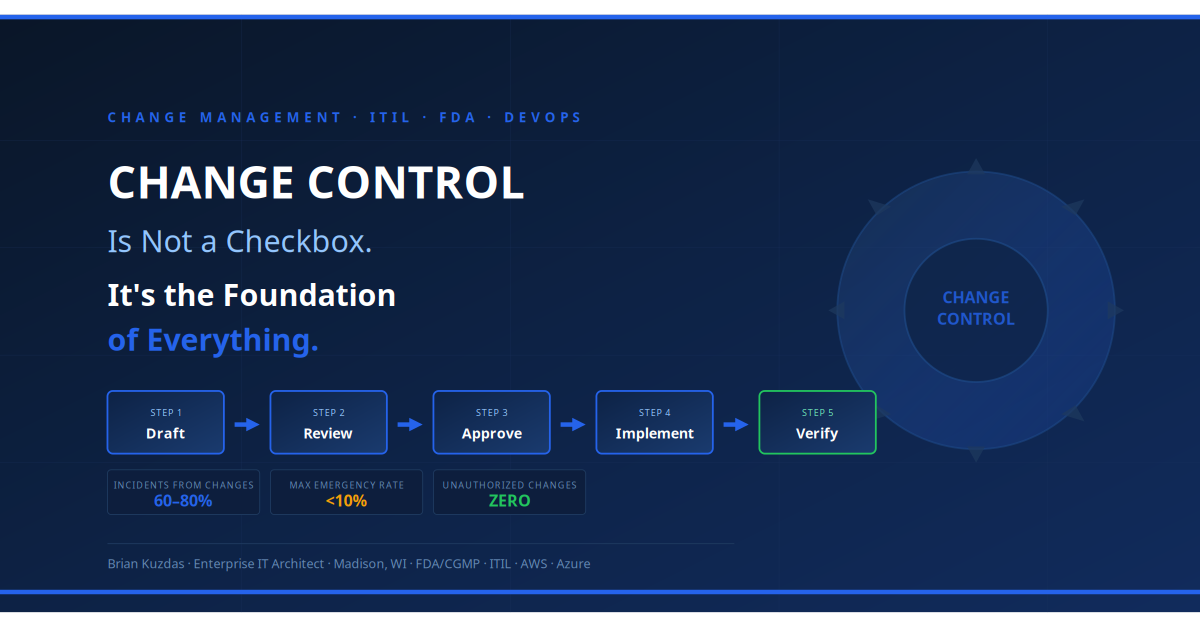
Change-to-incident correlation rate: What percentage of production incidents in the last 30 days were preceded by a change within the prior 72 hours? Industry research consistently shows that 60-80% of production incidents are change-related. If your organization is significantly above or below this range, investigate why.
Emergency change percentage: Emergency changes should represent less than 10% of total change volume. Higher rates indicate process bypass or planning failures that the process is not catching.
Average CAB cycle time: The time from change request submission to CAB approval should be predictable and appropriate for the risk tier. Standard changes should have near-zero review time (pre-approved). Normal changes should have a defined SLA. If cycle times are unpredictable, the process has reliability problems.
Unauthorized change rate: How many changes are discovered in logs, audits, or incidents that were not submitted through the change management process? Any non-zero rate indicates process compliance problems. In regulated environments, unauthorized changes are potential 483 observations.
PIR completion rate and action item closure: What percentage of changes above standard tier have completed PIRs? What percentage of PIR action items are closed within the defined timeline? Low completion rates indicate the organization is not learning from its changes.
Rollback rate: What percentage of changes are rolled back due to unexpected issues during or after implementation? Industry benchmarks suggest 5-10% rollback rates for normal changes; higher rates indicate inadequate testing or impact assessment.
Present these metrics monthly to IT leadership and quarterly to business leadership. Metrics that are never reviewed become meaningless. Metrics that are reviewed honestly drive continuous improvement.
ITIL vs. FDA vs. DevOps: Reconciling Frameworks
The most common objection to robust change management in modern organizations comes from DevOps practitioners: “Our deployment pipeline runs 50 times a day. We can’t run every deployment through a CAB.”
This is correct. And it’s not a contradiction.
ITIL 4 explicitly addresses this. The ITIL 4 Change Enablement practice introduces the concept of standard changes — pre-approved, low-risk, frequently performed changes that follow a defined procedure and do not require CAB review. A CI/CD pipeline deployment to a development or staging environment, following a defined process with automated testing and rollback capability, can absolutely be a standard change. The organization pre-approves the change type, not each individual instance.
The FDA has addressed this as well. FDA guidance on computer software assurance (CSA) released in 2022 moves away from document-heavy validation toward risk-based assurance. Automated testing pipelines, continuous integration with defined quality gates, and change management systems that provide audit trails are all acceptable — the requirement is not a paper-based CAB, it is evidence that changes are controlled, tested, and traceable.
The DevOps-FDA-ITIL synthesis looks like this:
- Standard/automated changes (CI/CD pipeline to non-production): pre-approved, automated, fast
- Normal changes (production deployment, configuration change): change request, automated testing evidence, lightweight CAB review or approval workflow
- Major/validated system changes: full change control, impact assessment, QA review
- Emergency changes: compressed review, post-hoc documentation, 48-hour retrospective
The framework isn’t the enemy of speed — the lack of a framework is. Organizations with mature, well-defined change management processes deploy faster than organizations with chaotic processes, because they spend less time recovering from self-inflicted incidents.
NIST SP 800-128 (Guide for Security-Focused Configuration Management) provides the security lens on change management: every change is a potential introduction of vulnerability or misconfiguration, and the change management process is a primary security control. This perspective is often missing from ITIL-focused discussions but is critical in regulated and security-sensitive environments.
Bottom Line: Building Change Control That Actually Works
The organizations that do this well share a common characteristic: they treat change management as an operational discipline, not a compliance burden. The process is designed to make changes go right — not to create paperwork that proves someone approved a decision that already happened.
1. Audit your current change classifications. Pull last quarter’s changes. What percentage were classified as emergency? What percentage were submitted after-the-fact? What is your rollback rate? If you don’t have these numbers, you don’t know whether your process works.
2. Build or update your standard change library. Identify the 20-30 change types that your organization performs routinely and consistently. Pre-approve them with defined procedures. This is where the speed comes from — not from bypassing review, but from eliminating review for changes that have already been reviewed.
3. Define your emergency change criteria explicitly. Write the specific conditions that qualify. Make the criteria narrow enough to be meaningful. Train your team on the criteria. Track the rate.
4. Implement PIRs for all major changes. Assign an owner. Set a 5-business-day deadline. Require action items. Report PIR completion rate to leadership.
5. For regulated environments: validate your change management process. Your change control SOP is part of your quality system. If it’s not documented, approved by QA, and auditable, it’s not compliant. This includes your emergency change procedure.
6. Connect change management to your SIEM. Correlate change events with infrastructure and application telemetry. Change-related incidents that are detected early are contained early. Change events that are invisible to your monitoring become unexplained anomalies that consume hours of investigation time.
Change control done right doesn’t slow you down. It is what allows you to go fast safely.
References and Further Reading
-
ITIL 4 Change Enablement Practice — AXELOS / PeopleCert. https://www.axelos.com/certifications/itil-service-management/what-is-itil
-
FDA 21 CFR Part 820 — Quality System Regulation (Medical Devices) — https://www.accessdata.fda.gov/scripts/cdrh/cfdocs/cfcfr/CFRSearch.cfm?CFRPart=820
-
ICH Q10: Pharmaceutical Quality System — International Council for Harmonisation. https://www.ich.org/page/quality-guidelines
-
NIST SP 800-128: Guide for Security-Focused Configuration Management of Information Systems — https://nvlpubs.nist.gov/nistpubs/SpecialPublications/NIST.SP.800-128.pdf
-
FDA Computer Software Assurance (CSA) Guidance (2022) — https://www.fda.gov/regulatory-information/search-fda-guidance-documents/computer-software-assurance-production-and-quality-system-software
-
GAMP 5 Second Edition: A Risk-Based Approach to Compliant GxP Computerized Systems — ISPE. https://ispe.org/publications/guidance-documents/gamp-5
-
Gartner: IT Change Management and Operational Excellence Research — https://www.gartner.com (subscription required)
#ChangeManagement #ITIL #FDA #CGMP #EnterpriseIT #GxP #DevOps #OperationalExcellence #RiskManagement #ITGovernance