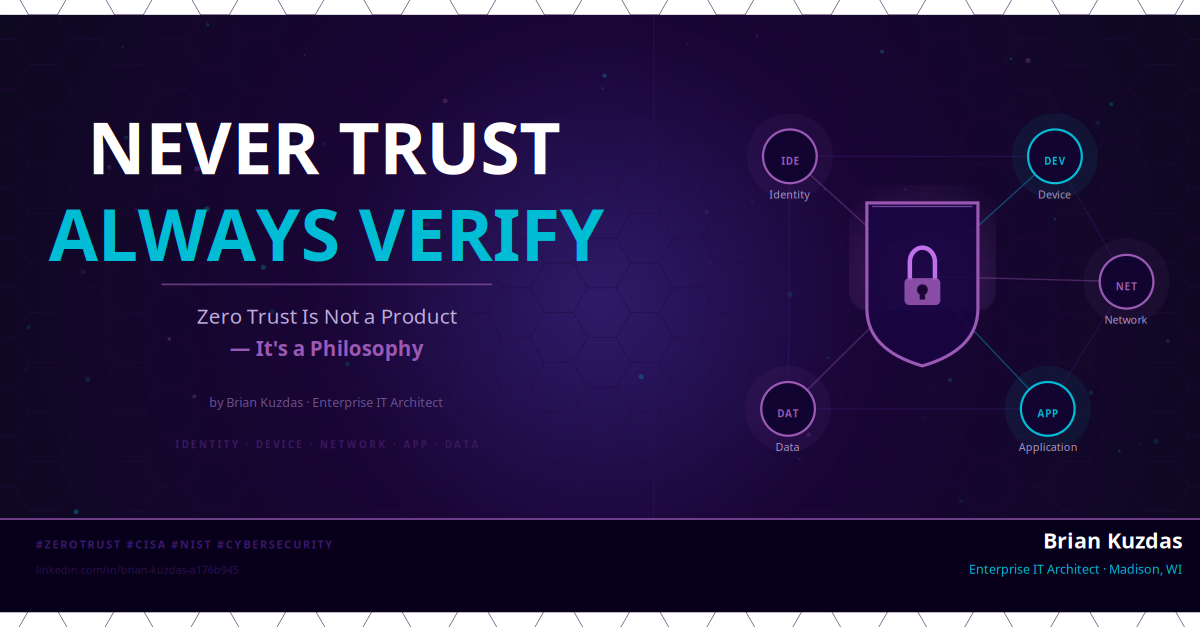
By Brian Kuzdas | Enterprise IT Architect | Madison, WI
If you’ve attended a cybersecurity conference in the last five years, you’ve heard “Zero Trust” more times than you can count. Vendors plaster it on banners. Sales engineers invoke it in every pitch deck. A product refresh gives birth to a brand new “Zero Trust Platform” practically every quarter. And somewhere in that noise, the actual meaning got buried.
Let me be direct: Zero Trust is not a product you can buy. It is not a next-generation firewall, a VPN replacement, a SASE platform, or a single vendor’s solution that you deploy and then confidently check “Zero Trust” off your security roadmap.
Zero Trust is a philosophy — a set of architectural principles that, when properly implemented, fundamentally changes how your organization thinks about trust, access, and verification. That distinction matters enormously, because misunderstanding it has led countless organizations to spend millions on products while leaving their core security architecture entirely unchanged.
After 25+ years in enterprise IT — including deeply regulated FDA/CGMP environments, HIPAA-governed healthcare systems, and financial infrastructure — I’ve watched the term “Zero Trust” weaponized by marketing departments in ways that actively mislead CISOs and their boards. This article is my attempt to cut through that noise with architectural clarity.
1. What Zero Trust Actually Means (Architecturally)
The phrase “never trust, always verify” was coined by John Kindervag at Forrester Research in 2010. At its core, it represents a fundamental departure from the traditional perimeter-based security model, which assumes that everything inside the network boundary can be trusted.
In the perimeter model, you build a wall — your firewall, your VPN — and anything inside that wall is implicitly trusted. The problem? The wall has thousands of gates. Once an attacker breaches the perimeter through phishing, credential theft, or a compromised endpoint, they move laterally through your environment with minimal friction. They become an authorized user inside a trusted network, and your controls never challenge them again.
Zero Trust dismantles that assumption entirely.
According to NIST SP 800-207: Zero Trust Architecture (2020), zero trust is defined as “an evolving set of cybersecurity paradigms that move defenses from static, network-based perimeters to focus on users, assets, and resources.” The key phrase is move defenses. This isn’t about adding a product on top of your existing perimeter. It’s about a fundamental restructuring of how trust is established, validated, and continuously maintained.
Architecturally, Zero Trust means:
- No implicit trust based on network location — being inside the VPN grants you nothing
- Every access request is authenticated, authorized, and continuously validated in real time
- Access is granted on the principle of least privilege, scoped to the specific resource needed
- All communications are treated as if they traverse an untrusted network — even internal east-west traffic
This is not a technology deployment. This is an architectural philosophy that reshapes every layer of how your environment operates.
2. What Zero Trust Is NOT
Let’s address the elephant in the room, because the vendor marketing noise has created genuine confusion at the executive and board level.
Zero Trust is not:
- A next-generation firewall with “Zero Trust” in the product name
- A VPN replacement (though Zero Trust Network Access — ZTNA — is one relevant control)
- A marketing checkbox that a vendor checks after a software update
- Achievable through deploying a single platform
- A project with a start date and a go-live date
Every major vendor — Microsoft, Palo Alto Networks, Zscaler, CrowdStrike, Okta — offers products that support Zero Trust architecture. Many of them are excellent tools. The confusion arises when organizations conflate purchasing those products with implementing Zero Trust.
Deploying a ZTNA solution gives you strong network-level access control for application access. But if your identity governance is broken, your device health attestation is nonexistent, east-west traffic inside your VPC is unrestricted, and your service accounts still have standing privileged access — you do not have Zero Trust. You have an expensive tool inside a fundamentally unchanged architecture.
Gartner’s Market Guide for Zero Trust Network Access explicitly cautions that “ZTNA alone is not Zero Trust” — it is one component of a much broader architectural transformation.
The Forrester Zero Trust eXtended (ZTX) Ecosystem framework — which evolved directly from Kindervag’s original model — makes this clear: Zero Trust must span networks, devices, people, workloads, data, visibility, and automation simultaneously. No single product covers all of these dimensions. No vendor’s platform solves all of these problems.
If a sales engineer tells you their product delivers Zero Trust, ask them to map it to the CISA maturity model pillars. The answer will reveal everything.
3. The Five Pillars of Zero Trust
The CISA Zero Trust Maturity Model (Version 2.0, 2023) organizes Zero Trust architecture across five foundational pillars. Understanding these pillars is the starting point for any serious implementation effort.
Pillar 1: Identity
Identity is the new perimeter. Every user, every service account, every API key, every non-human identity must be continuously authenticated and authorized — not just at login, but throughout the session based on risk signals and behavioral context.
This goes well beyond enabling MFA. True Zero Trust on the Identity pillar requires:
- Phishing-resistant MFA (FIDO2/WebAuthn) for all users — not just TOTP
- Privileged Access Management (PAM) for all elevated and administrative accounts with just-in-time access
- Conditional Access policies that evaluate risk in real time: device compliance, location, anomalous behavior, sign-in risk score
- Identity governance and administration (IGA) with automated access reviews, lifecycle management, and role certification
- Elimination of standing privileged access and long-lived credentials wherever possible
If your service accounts still have 90-day rotating passwords and broad group membership, you have not begun Zero Trust on this pillar.
Pillar 2: Device
Identity is only half the story. The security posture of the device from which an authenticated user connects is equally critical. A phishing-resistant identity combined with a compromised, unmanaged device is still a catastrophic risk.
Device pillar requirements include:
- Device inventory with real-time health and compliance status
- Endpoint Detection and Response (EDR) with behavioral analysis and health attestation signals fed into your Conditional Access framework
- Mobile Device Management (MDM) coverage across all corporate and BYOD endpoints with policy enforcement
- Patch compliance enforcement — unpatched devices should fail health checks and be denied access to sensitive resources
- Certificate-based device identity replacing password-based device authentication
Pillar 3: Network
Network segmentation is where Zero Trust delivers the most immediate security ROI against lateral movement — and where many organizations have made the least progress. The flat, trusted internal network is the primary enabler of catastrophic breach outcomes.
Key Network pillar requirements:
- Micro-segmentation of workloads — east-west traffic between services must be explicitly permitted, not implicitly allowed
- Software-defined perimeters granting network access per application and per session, not per-network segment
- Encrypted communications everywhere, including internal traffic (mTLS for service-to-service communication)
- Network monitoring and anomaly detection to identify unusual lateral movement patterns
- Elimination of implicit trust for any network segment, including production, DMZ, and cloud VPCs
The IBM Cost of a Data Breach Report consistently shows that breaches involving lateral movement are significantly more costly and take measurably longer to contain than breaches stopped at the point of initial compromise. Micro-segmentation is the control that limits what an attacker can reach after initial access.
Pillar 4: Application
Applications themselves must enforce Zero Trust principles. Network-level controls alone are insufficient when application-layer trust assumptions remain intact.
Application pillar requirements include:
- Application-level authentication and authorization — not just “did you get past the network perimeter?”
- API security with token-based authentication (OAuth 2.0, OIDC), scoped tokens, and short-lived credentials
- Application access gateway or proxy patterns that inject authentication context rather than trusting network location
- Continuous threat detection within application workloads, not just at the network boundary
- Zero Trust for CI/CD pipelines — build-time identity, secrets management, signed artifacts, supply chain controls
Even with strong identity and network controls, if your applications implicitly trust any request arriving from a specific subnet or internal network range, that trust assumption is an exploitable gap.
Pillar 5: Data
Data is ultimately what attackers want. The data pillar closes the loop by ensuring that even if every other control is bypassed, data itself is protected, classified, and auditable.
Data pillar requirements:
- Data classification and labeling at rest and in transit, enforced consistently across cloud and on-premises
- Data Loss Prevention (DLP) policies aligned to data classification tiers
- Encryption at rest with proper key management (HSMs, cloud KMS with appropriate key isolation)
- Comprehensive access logging and auditing for all sensitive data access — who, what, when, from where
- Data-centric security policies that travel with the data, not just with the infrastructure
In regulated environments — FDA/CGMP, HIPAA, SOX, PCI-DSS — this pillar is frequently the primary driver for Zero Trust investment, because regulatory frameworks demand exactly this level of data-centric control and audit capability.
4. How to Start Without Buying Anything
Here is the uncomfortable truth that no vendor will tell you in a sales call: you can make significant Zero Trust progress without purchasing a single new product.
Start with what you have.
Enforce MFA everywhere, unconditionally. Every major identity provider — Azure AD/Entra ID, Okta, Ping Identity, Google Workspace — supports MFA. Enable it for all users, all applications, no exceptions. Eliminate the exception lists. This single action raises the cost of credential-based attacks by orders of magnitude and can be done this week.
Conduct a least-privilege access review. Export your RBAC assignments, group memberships, IAM policies, and service account permissions. For each assignment, ask: does this user or system actually need this level of access to do their job? You will find massively over-privileged accounts. Remediate them. This costs nothing but organizational will and analyst time.
Segment your network. If your production environment is a flat network where any workload can reach any other workload on any port, your east-west risk is catastrophic. Start by documenting required communication paths between services and building firewall rules to deny everything else. Your existing firewall infrastructure almost certainly supports this today.
Inventory your devices. Before you can apply device health policies, you need to know what devices exist. Your existing endpoint management tools — Microsoft Intune, Jamf, SCCM — can provide this inventory. Identifying unmanaged devices on your network costs nothing and may surprise you.
Audit your service accounts and API keys. Identify long-lived credentials, document ownership, and begin a rotation and scoping program. Most organizations discover service accounts with domain admin rights that were created for a one-time project three years ago and never removed.
None of these steps require a budget line item. They require leadership commitment and organizational rigor.
5. Common Zero Trust Mistakes
After advising on Zero Trust implementations across multiple enterprise environments spanning healthcare, life sciences, and financial services, I see the same five mistakes repeatedly.
Mistake 1: Buying a “Zero Trust Platform” without changing your architecture. Products from Zscaler, Palo Alto Prisma Access, Microsoft Defender XDR, and others are excellent tools. But deploying them without addressing underlying architecture is like installing a biometric deadbolt on a door with no frame. The product is excellent. The strategy is missing.
Mistake 2: Treating Zero Trust as a perimeter replacement. Zero Trust doesn’t eliminate your perimeter. It makes your perimeter insufficient as your primary trust boundary — because it assumes breach everywhere. You still maintain boundary controls, but you stop relying on them as your only line of defense.
Mistake 3: Ignoring east-west traffic. Most programs focus on north-south traffic (users accessing applications from outside). East-west traffic — workload to workload, service to service, database to application — is where lateral movement propagates. The CISA model explicitly calls out micro-segmentation as a core Network pillar requirement. Organizations that ignore east-west controls are leaving the primary attack propagation path wide open.
Mistake 4: Non-human identity blindspots. Service accounts, API integrations, automation pipelines, CI/CD credentials — these non-human identities often have excessive permissions, weak or absent authentication, and no governance. They are the preferred attack vector in many sophisticated intrusions. If your Zero Trust program only covers human user accounts, it has enormous exploitable gaps.
Mistake 5: Declaring success at a product deployment. Zero Trust is a maturity journey measured in years, not a project with a go-live date. The organization that declares “we implemented Zero Trust” after deploying ZTNA in Q3 is potentially more exposed than one that honestly acknowledges it is at Traditional maturity and has a clear roadmap to Optimal. Self-awareness and accurate maturity assessment are security advantages.
6. Zero Trust Maturity Model: Where to Start and How to Measure Progress
The CISA Zero Trust Maturity Model (Version 2.0, April 2023) defines four maturity stages across all five pillars:
- Traditional — Implicit trust based on network location. Static, manually maintained policies. Little to no automation in response.
- Initial — Some attribute-based and context-aware access controls. Automation beginning in isolated areas. Lifecycle management processes emerging.
- Advanced — Cross-pillar integration with automated policy enforcement. Continuous validation across multiple pillars. Automated response and remediation in key areas.
- Optimal — Fully dynamic, risk-scored, data-driven policy. Zero implicit trust anywhere. Machine learning-informed decisions with closed-loop automated response.
Most enterprise organizations I encounter are at Traditional to Initial across most pillars. That is not a failure — it is an honest starting point. The value of the maturity model is that it provides a structured, defensible framework for measuring progress, prioritizing investments, and communicating posture to boards and regulators.
My recommended maturity progression sequence:
- Identity first. Enforce phishing-resistant MFA. Implement PAM for privileged accounts. Begin access governance and certification cycles.
- Device second. Achieve device inventory completeness. Enforce compliance-based Conditional Access — deny access from unmanaged or non-compliant devices.
- Network third. Segment production environments. Restrict east-west traffic between critical workloads.
- Application fourth. Implement application-layer authorization. Harden API security. Implement Zero Trust for CI/CD pipelines.
- Data fifth. Classify and label data assets. Implement DLP. Achieve comprehensive audit logging.
This sequence reflects where most organizations can achieve the highest immediate risk reduction relative to investment. Identity-based attacks account for the majority of initial access in modern breaches — which is why Identity is almost always the highest-ROI pillar to mature first.
Metrics that indicate real Zero Trust progress:
- % of users enrolled in phishing-resistant MFA (target: 100%)
- % of privileged access managed through PAM with just-in-time provisioning
- % of production workloads with micro-segmentation enforced
- Mean Time to Detect (MTTD) and Mean Time to Respond (MTTR) for identity-based attack patterns
- % of service accounts with scoped, time-limited credentials
- Access certification completion rate and over-privileged access remediation rate
- % of API integrations using short-lived tokens vs. long-lived static API keys
These are the metrics that tell a board what Zero Trust actually means in practice. Not the number of products deployed.
The Bottom Line
Zero Trust is the right security architecture philosophy for the modern threat landscape. Attackers target identities, not network perimeters. Ransomware operators move laterally for weeks before detonating payloads. Cloud infrastructure dissolves the traditional network boundary entirely. Remote work erased the last meaningful distinction between “inside” and “outside” your network.
The organizations extracting real security value from Zero Trust investments share a consistent set of characteristics:
- They started with architecture principles, not vendor selection
- They measure maturity against CISA and NIST frameworks, not product coverage dashboards
- They treat Identity as the foundation — because identity is where the majority of attacks begin
- They explicitly address east-west controls with the same rigor as north-south
- They commit to a multi-year program with measurable milestones, not a project with a launch date
If you are a CISO preparing a board presentation: the slide that says “we’ve implemented Zero Trust” because your team deployed a ZTNA product is the slide that will come back to haunt you after the next incident. The honest version of that presentation maps your current maturity against the CISA model, shows measurable progress across the five pillars, and presents a clear roadmap for the next 18 months.
That is the Zero Trust conversation worth having — and the one that actually improves your security posture.
References
-
NIST SP 800-207: Zero Trust Architecture (August 2020). National Institute of Standards and Technology. Rose, S., Borchert, O., Mitchell, S., Connelly, S. https://csrc.nist.gov/publications/detail/sp/800-207/final
-
CISA Zero Trust Maturity Model, Version 2.0 (April 2023). Cybersecurity and Infrastructure Security Agency. https://www.cisa.gov/zero-trust-maturity-model
-
Market Guide for Zero Trust Network Access. Gartner Research, Lawrence Orans, Steve Riley. https://www.gartner.com/en/documents/3987329
-
Microsoft Zero Trust Guidance Center. Microsoft Security Documentation. https://learn.microsoft.com/en-us/security/zero-trust/
-
IBM Cost of a Data Breach Report 2023. IBM Security / Ponemon Institute. https://www.ibm.com/reports/data-breach
-
The Zero Trust eXtended (ZTX) Ecosystem. Forrester Research. Original Zero Trust model by John Kindervag (2010). https://www.forrester.com/report/the-forrester-wave-zero-trust-network-access/
#ZeroTrust #CyberSecurity #SecurityArchitecture #NIST #CISA #CloudSecurity #IAM #EnterpriseSecurity