By Brian Kuzdas | Enterprise IT Architect | Madison, WI
Let me tell you about a hiring process I watched unfold at a Fortune 500 company.
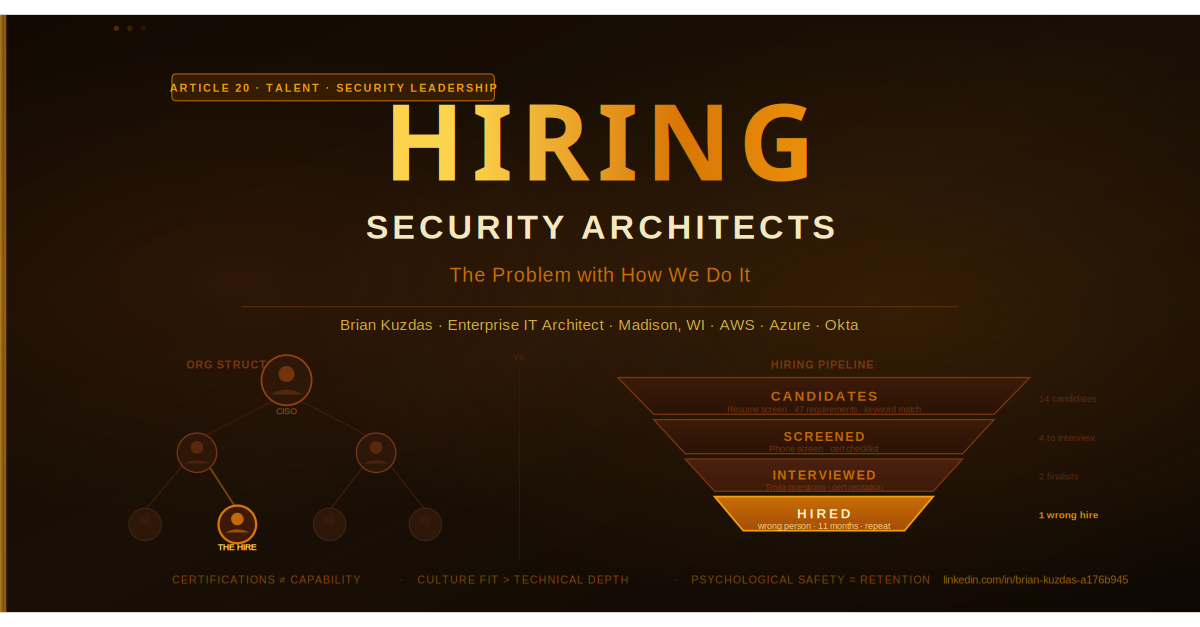
The role: Senior Security Architect. The recruiting team produced a job description with 47 requirements — CISSP, CISM, CEH, five years of cloud security, five years of zero trust, five years of SIEM experience, and a master’s degree “preferred.” Compensation: slightly below market. Timeline: “we’d like to fill this urgently.”
Fourteen candidates were screened by HR based on keyword matching. Four made it to technical interviews. The interviews consisted of twenty-three trivia questions pulled from a certification study guide. The winner: the candidate who had memorized the most acronyms.
That hire lasted eleven months. When they left, they took six months of institutional knowledge with them, and the company started the same process over again.
This is not an unusual story. This is the dominant pattern in how enterprises hire security architects. And it is costing the industry billions — in turnover costs, in mediocre security outcomes, and in the security talent that quietly leaves for organizations that understand what they’re actually hiring for.
I’ve been on both sides of this table — as a hiring manager, as a candidate, and as a consultant evaluating security organizations. Here’s what I’ve learned.
Certifications Are a Poor Proxy for Security Ability
The CISSP is not a worthless credential. It demonstrates that someone studied a broad body of knowledge, passed a difficult examination, and has logged professional experience in the field. For many organizations, it provides a useful baseline filter.
But here is what a CISSP does not tell you:
- Whether the candidate can architect a zero-trust network migration for a 20,000-user enterprise
- Whether they have successfully led an incident response involving a nation-state actor
- Whether they can explain why your $3 million SIEM investment isn’t detecting the threats it should
- Whether they can walk into a board meeting and represent security risk credibly to executives who hold their own engineering credentials
The “check the box” hiring culture has emerged because HR departments and external recruiters often lack the subject matter expertise to evaluate security architects. Certifications are legible, searchable, ATS-scannable, and defensible. “This person thinks like a security architect” is not a keyword.
The result: we systematically filter for test-takers and miss practitioners.
The ISC² Cybersecurity Workforce Study estimates a global shortage of approximately 4 million cybersecurity professionals as of 2023. The shortage is not uniform — it is heaviest precisely in the roles that require the most complex judgment: experienced architects, incident response leaders, and cloud security strategists. The roles where certification-checking is most inadequate as a selection method.
ISACA’s State of Cybersecurity Report (2023) found that 56% of cybersecurity hiring managers believe their organization’s security skills gaps are increasing even as they continue to hire. If hiring is happening but gaps are growing, the problem is selection criteria, not supply. We are hiring the wrong thing.
The Interview Questions That Actually Reveal Skill
The technical trivia interview is broken. “What port does SMTP use?” tells you nothing about architectural thinking. “What’s the difference between IDS and IPS?” tells you someone read a textbook.
Here are the questions that actually work:
“Walk me through the most significant security failure you’ve been responsible for, and what you learned.”
This question is a Rorschach test. Three patterns of response reveal everything:
The Deflector answers “I haven’t really had any significant failures” or “there was a situation with my previous team, but it wasn’t really my fault.” This reveals a lack of self-awareness and accountability. In security, where post-incident learning is foundational, this response is disqualifying regardless of technical depth.
The Reciter delivers a polished, rehearsed story with appropriate buzzwords that sounds like it was practiced in front of a mirror. Follow up by asking: “What specifically would you do differently today?” Watch carefully for whether the follow-up answer is genuinely reflective or another performance.
The Grower tells a real story with appropriate vulnerability. The failure is specific, the consequences are acknowledged, and the learning has visibly changed how they work. They don’t need to sanitize the story because they’ve made peace with it. This is the person you want.
”How would you explain to a CFO why we need to invest $2 million in identity and access management?”
Security architects who cannot communicate risk in business terms are architects in title only — because security decisions are ultimately business decisions. The answer you want: some version of “I would tie the IAM investment to specific, quantifiable business risks and model the expected loss reduction the investment provides.” The answer that concerns you: a technical explanation of what IAM does, delivered at a pace that would put a CFO to sleep.
”Describe a time you had to push back on a technical direction that a more senior person was advocating.”
Security architects routinely need to say no to people who outrank them in the organizational chart. Or more precisely, they need to say: “Here is what this architectural decision costs us in risk. Here is an alternative path. Here is my recommendation, and I’m willing to own it.” A security architect who cannot constructively disagree with executives will be steamrolled — and then they’ll either become complicit in poor security decisions or they’ll leave. Either outcome is expensive.
”What is the last significant security concept you completely changed your mind about?”
The threat landscape evolves faster than any other technical domain. The person who hasn’t meaningfully updated their mental model in the past two or three years hasn’t been paying close enough attention. This question tests intellectual humility and genuine continuous learning. Great answers include specifics: a tool they stopped advocating for, an architecture pattern they abandoned, a threat model they fundamentally revised.
The Difference Between a Security Engineer and a Security Architect
This distinction matters far more than most job descriptions acknowledge — and confusing the two produces bad hiring outcomes in both directions.
Security Engineers implement. They deploy the SIEM, write the detection rules, run vulnerability scans, respond to alerts, configure WAF rules, and tune security tooling. These are skilled, high-value roles that require both technical depth and operational discipline. The best security engineers are meticulous, systematic, and excellent at working within defined parameters.
Security Architects design, govern, and communicate risk. They decide which SIEM and why — and they can defend that decision to a committee, a board, and a regulator. They translate business requirements into security controls and translate security findings into business language. They define strategy, set standards, evaluate architectural trade-offs, and serve as the security conscience of the organization’s technology decisions.
The critical distinction: a security architect must be comfortable being wrong out loud in front of executives.
That sentence deserves to stand alone for a moment. Architecture involves making consequential decisions under uncertainty, with incomplete information, under time pressure, in front of people who will scrutinize the outcome. When an architect’s recommendation turns out to be wrong — and it will, at some point — they need to own the decision, update their model publicly, and maintain their credibility through honesty rather than defensiveness.
Most people find this deeply uncomfortable. Engineers especially, because engineering culture rewards precision and punishes mistakes. The best security architects have developed a fundamentally different relationship with uncertainty — one that acknowledges what they don’t know, makes the best decision available with current information, and remains genuinely open to revision.
Gartner’s research on security architect effectiveness consistently identifies communication competency as the single highest-differentiating factor between high-performing and average security architects — not technical depth, not certification count, not years of experience. When you are hiring a security architect, you are hiring a thinking partner for your CISO and your business leadership. Screen accordingly.
Why Culture Fit Beats Technical Skills in Security Roles
I have watched technically brilliant security professionals destroy security programs.
The pattern is consistent: a deeply skilled engineer is hired as an architect because of their technical expertise — often justified, because they genuinely know more than most people in the room about the specific technology domain. And they use that expertise as a weapon.
They create a culture of fear in which asking a basic security question feels like inviting humiliation. They hoard knowledge — becoming a single point of failure who controls access to their domain, either through design or through the social dynamics they’ve created. They refuse to collaborate — treating requests from application teams, product managers, and business stakeholders as intrusions on their time rather than as the actual mission of security.
The result: the organization works around them. Security reviews become a formality because teams have learned that engaging with this person early just means getting told “no” in a way that delays their project. The security team becomes isolated from the business. And eventually, the organization finds ways to get things done without security’s involvement — which is the worst possible outcome.
A technically average security architect who builds relationships, communicates clearly, treats every team as a customer, and creates an environment where people feel comfortable raising security concerns early will deliver dramatically more security value than a technically brilliant person who creates friction at every interaction.
Security is a team sport. Attackers collaborate, share tools, and build on each other’s work. Defenders need to do the same. Your security architect sets the cultural tone for your entire security program. Choose that person with as much care as you’d choose a CISO — because in many organizations, the security architect is the person who does the work that a nominal CISO takes credit for.
Harvard Business Review research on high-performing security teams consistently identifies psychological safety — the organizational belief that it is safe to raise concerns, ask questions, admit mistakes, and challenge assumptions — as the most powerful predictor of team security effectiveness. Not tooling. Not headcount. Not certifications. Psychological safety.
When you are evaluating a security architect candidate, ask honestly: “Will this person make our team psychologically safer or less safe?”
How to Retain Security Talent
SHRM research estimates the cost of replacing a mid-to-senior level employee at 50–200% of annual salary. For a senior security architect earning $180,000, that is $90,000 to $360,000 per departure. When you add the six months before a replacement is productive, the missed security initiatives that stalled during the vacancy, and the institutional knowledge that walked out the door, a realistic estimate of $250,000 to $400,000 per departure is not unusual.
Security architects leave — and they leave with accelerating frequency. The average tenure of a security architect at a single organization is 2–3 years and declining. When they exit and honest offboarding conversations happen, the stated reasons cluster predictably:
Leadership doesn’t act on security recommendations. Security architects who repeatedly make well-reasoned recommendations that are documented, escalated, and then quietly shelved eventually stop making recommendations. The work becomes theater. Then they leave.
The tools don’t match the threat environment. Being expected to defend against sophisticated modern adversaries using a SIEM deployed in 2015, with an alert queue that is never actually investigated, creates a particular kind of professional demoralization. Security architects know when the organization isn’t serious. The tools they’re given are a signal.
No time for continuous learning. The security threat landscape evolves faster than any other technical domain — faster than cloud architecture, faster than networking, faster than application development. Security architects who cannot maintain currency become irrelevant within three to five years. Organizations that treat continuing education as an optional benefit rather than a professional necessity are telling their security architects something about how seriously they take the function.
Compensation falls behind the market. Security compensation has been rising faster than average IT compensation for over a decade. Organizations that do not conduct external market assessments annually routinely find themselves 20–30% below market before the discrepancy becomes obvious — and by then, it is often too late to retain.
The environment is psychologically unsafe. Being the person who says “this isn’t secure enough” makes you systematically unpopular in an organization moving fast. Organizations that shoot the messenger — that treat security concerns as obstacles to delivery rather than information about risk — drive out their best security talent. The people who stay in that environment aren’t the ones you wanted to keep.
The retention formula is not complex: pay market rates, provide tools that are adequate to the mission, protect time for continuous learning, take action on security recommendations, and create an environment where raising concerns is rewarded rather than penalized. The organizations that consistently do this have security architects who have been with them for ten years. The organizations that don’t have a revolving door — and a security program that never quite matures.
Building the Team You Actually Need
The most expensive mistake in security hiring is building a resume stack instead of a team.
Here is what that looks like in practice: you have a security architect opening. You collect resumes. You find the candidate with the most impressive certification list and the longest roster of enterprise brands on their CV. You make an offer, believing you have hired the best available talent. That person knows enterprise security at a general level, but they don’t know your industry, your specific regulatory context, your threat landscape, your organizational culture, or the history of decisions that have created your current security posture. Six months in, they are still finding their footing. Twelve months in, they may be doing competent work — or they may have already decided to leave.
Define the role by outcomes, not credentials. Before posting the job description, answer three questions: What does success look like at 90 days? At one year? At three years? What relationships does this person need to have built? What specific problems need to be solved? Work backward from those outcomes to the actual requirements. You will almost certainly find that the certification list is not where the critical criteria are.
Consider internal candidates seriously. The mid-level security engineer who has been with your organization for four years knows the environment in ways that no external hire can replicate immediately. They know where the real risks are, who the important stakeholders are, what has been tried before and why it failed, and which organizational relationships matter for getting security work done. Their technical skill gaps are addressable through mentoring, training, and experience. Their institutional knowledge is not transferable.
Value domain expertise. A security architect with ten years of experience in pharmaceutical or healthcare IT is worth substantially more to a life sciences organization than a generic enterprise security architect with a longer certification list. Domain expertise means they understand the threat landscape specific to your industry, the regulatory requirements that shape your security obligations, the business risks that make certain security failures catastrophic, and the organizational dynamics that make security decisions politically complex. You pay for that expertise by not spending eighteen months educating someone about what your business actually does.
The research is clear. ISC²’s organizational security effectiveness studies find that organizations with security architects who have deep domain knowledge in their industry achieve measurably better security outcomes than those who rely on generic credentials alone. This is not surprising. Security without context is not security — it is compliance theater.
Build a team where the whole is greater than the sum of its certifications. That means assembling people with complementary strengths: technical depth, communication capacity, domain expertise, and the cultural maturity to build security into the fabric of how the organization works — rather than applying it as a friction layer at the end.
Bottom Line
The security architect hiring crisis is largely self-inflicted. We built credential-worship into our recruiting processes, we constructed broken interview formats that test memory rather than judgment, and we wonder why we cannot find the talent we need. The shortage is real, but the problem is also one of selection.
Practical takeaways:
-
Redesign your interview around scenarios and reflection, not trivia. Replace “What port does SMTP use?” with “Walk me through the hardest security decision you’ve made under uncertainty.” The answers will tell you far more.
-
Stop confusing certifications with capability. Treat certifications as a baseline signal that someone is serious about the profession. They are not evidence of architectural skill, communication ability, or leadership potential. Don’t hire to the certification list.
-
Hire the communicator first. A security architect who cannot explain risk in business terms is an architect in title only. Technical depth can be developed. The ability to influence executives and build cross-functional relationships is far harder to teach.
-
Define the role by outcomes. What does success look like at 90 days, one year, three years? Hire to those outcomes. The job description should follow from the outcomes, not the other way around.
-
Invest in retention as aggressively as you invest in recruiting. The cost of losing your security architect is substantially higher than the cost of keeping them. Act accordingly: market-rate compensation, tools that work, time for learning, action on recommendations.
-
Look inside before you look outside. Your best available security architect may already work for you. Give them a clear path, a sponsor, and the opportunity to grow into the role.
Security is ultimately a people problem that manifests as a technology problem. The organizations that understand this hire differently — and they build security programs that actually work, year over year, because the people in them are invested in making them succeed.
References & Citations
-
(ISC)² Cybersecurity Workforce Study, 2023 — Global cybersecurity workforce gap estimate of approximately 4 million professionals. https://www.isc2.org/Research/Workforce-Study
-
ISACA State of Cybersecurity 2023 — Annual survey on hiring challenges, skills gaps, and workforce trends. https://www.isaca.org/resources/reports/state-of-cybersecurity-2023
-
SHRM Employee Turnover Research — Cost of employee replacement analysis. https://www.shrm.org/resourcesandtools/hr-topics/talent-acquisition
-
Gartner Security and Risk Management Research — Security architect effectiveness and communication competency studies. Gartner, Inc.
-
Edmondson, Amy C. — The Fearless Organization: Creating Psychological Safety in the Workplace. Wiley, 2018. Foundational research on psychological safety and team performance.
-
Harvard Business Review — Multiple publications on psychological safety in security and technical teams (2018–2023).
-
DORA State of DevOps Report, 2023 — Google/DORA Research Program. https://dora.dev/research/2023/dora-report/
-
“Measuring the Business Value of IT Security Architecture” — Various Gartner and Forrester publications on security ROI measurement.
-
Bureau of Labor Statistics — Information Security Analysts Outlook, 2023–2033. https://www.bls.gov/ooh/computer-and-information-technology/information-security-analysts.htm
#CyberSecurity #HiringTips #SecurityArchitect #TalentStrategy #ZeroTrust #IAM #CISSP #CISOInsights #EnterpriseIT #SecurityCulture #TechLeadership #InfoSec #TechHiring #Workforce #SecurityStrategy