Picture this: The CISO walks into the boardroom with a PowerPoint deck. Slide three shows 1,247 open CVEs, a mean time to detect of 8 days, and a CVSS heatmap that looks like a heat-mapped city — oranges and reds covering nearly every system in the portfolio. The presentation is thorough, technically accurate, and professionally designed.
The board nods politely. Someone asks whether the budget ask is “in line with industry benchmarks.” The CFO glances at the quarterly revenue slide on the table. The motion carries. The CISO walks out with a modest budget approval and the gnawing sense that nothing actually changed.
The problem here isn’t the data. The CISO was reporting accurate, meaningful security information. The problem is translation — or rather, the complete absence of it.
Security teams speak in the language of vulnerabilities, threat actors, and mean time to remediate. Boards speak in the language of liability, reputation, and business continuity. These are not the same language. And in my 25+ years working across enterprise IT, healthcare systems, and FDA/CGMP-regulated environments, I’ve watched this translation failure play out hundreds of times. The solution isn’t simpler slide decks. It’s a fundamentally different communication framework — one that maps every security metric directly to a business risk that board members actually lose sleep over.
This article is that framework.
Why Technical Security Metrics Fail at Board Level
Let’s be blunt: CVSS scores mean nothing to a board director. A CVSS score of 9.8 is terrifying to a security engineer who understands what it means. To a board member with a background in finance or operations, it’s a number without context, without consequence, and without a call to action.
CVE counts, mean time to detect (MTTD), mean time to respond (MTTR), patch coverage percentages — these are operational metrics. They measure activity. They tell you what your security team is doing. They don’t tell the board what they need to know: how exposed is the organization, what would a breach actually cost us, and what are we doing about the things that matter most?
The fundamental error most security reporting makes is conflating three very different concepts:
- Security activity (what we did this quarter)
- Security posture (how exposed we are right now)
- Security risk (what it would cost us if something goes wrong)
Boards should care primarily about the last two. They’re largely indifferent to the first — unless the activity produced a measurable posture improvement or risk reduction.
The numbers back this up: according to the NACD/Proofpoint 2023 Cyber-Savvy Board Director Survey, only 12% of board members feel “fully informed” about their organization’s cyber risk. That’s not because boards are unsophisticated — it’s because security teams are handing them information that requires a security engineering degree to interpret. The translation isn’t happening.
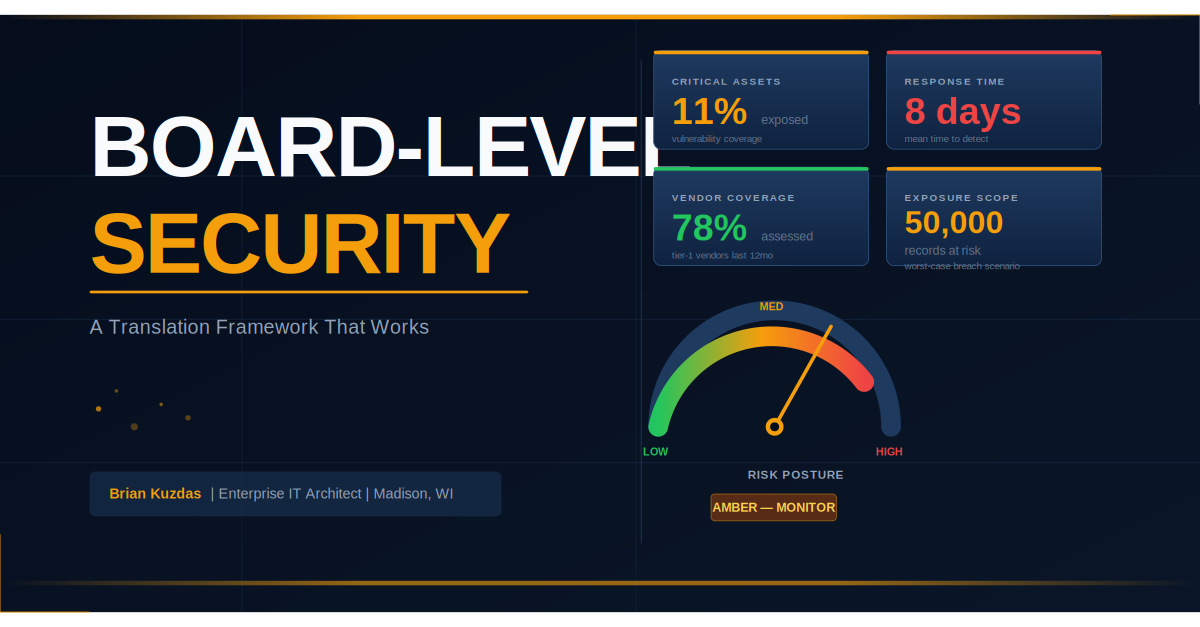
The fix isn’t to dummy things down. It’s to reframe entirely. Instead of “we patched 847 vulnerabilities this quarter,” say “we reduced our critical asset exposure from 34% to 11%, which takes our regulatory breach penalty exposure from an estimated $3.2M to under $800K.” Same underlying work. Completely different business signal.
The Three Business Risks Boards Actually Care About
Before you can translate security metrics, you need to understand what frame of reference your audience is actually using. Board members don’t think about vulnerabilities — they think about risks to the organization’s survival and reputation. Those risks cluster into three categories.
1. Legal and Regulatory Liability
Every regulated industry has a penalty framework, and boards are acutely aware of it — or should be. In healthcare, HIPAA’s Office for Civil Rights (OCR) can levy penalties up to $1.9 million per violation category per year. The SEC’s cybersecurity disclosure rules, finalized in July 2023, now require public companies to disclose material cybersecurity incidents within four business days — and to describe their cyber risk management practices in annual filings. State privacy laws — CCPA, CPRA, Illinois BIPA, Virginia CDPA — carry their own penalty structures. GDPR, for organizations with EU exposure, scales penalties to 4% of global annual revenue.
The question to answer for your board: What regulations govern our data, what are the specific penalty ranges, and what is our current estimated exposure? Turn that into a dollar figure. “We have 14 HIPAA-covered systems with known vulnerabilities that could trigger mandatory breach notification” is a board-level statement. “We have 14 HIPAA-covered systems with CVSS scores above 7.0” is not.
2. Reputational Risk
Could a breach at your organization make front-page news? If you handle consumer data, healthcare records, financial information, or critical infrastructure, the answer is almost certainly yes. And boards know that reputational damage from a breach can far outlast the breach itself.
Equifax is still the textbook case: their 2017 breach exposed 147 million consumer records, and the resulting reputational damage contributed to a loss of more than $4 billion in market capitalization in the month following disclosure. The CEO resigned. Congressional hearings followed. The company spent years rebuilding trust.
For private organizations, the calculus is different but no less real — lost clients, failed sales cycles, regulatory scrutiny, and partner relationships that quietly atrophy. When you’re reporting to a board, reputational risk needs to be quantified as best you can: estimated customer churn, projected revenue impact, brand damage measured in time-to-recovery.
3. Operational Risk
Can a breach stop your business? For how long? What does each day of downtime actually cost?
Ransomware has made this question viscerally concrete. According to Coveware’s Q3 2023 Ransomware Marketplace Report, the average ransomware downtime is 21 days. For a healthcare system with $10M in daily revenue, that’s $210M in potential impact before you factor in recovery costs, ransom payments, and regulatory fines. For a manufacturer with just-in-time supply chains, a week of operational paralysis can disrupt customer contracts that took years to build.
Operational risk also includes third-party dependencies. If your most critical SaaS vendor goes down — or gets breached — what happens to your operations? The SolarWinds incident reminded every organization that supply chain risk is operational risk.
The rule: map every security metric you report to one of these three risk categories. If you can’t map it, cut it from the board presentation.
Translating CVEs Into Business Language
This is where the framework becomes tactical. The translation principle is straightforward: quantify the blast radius, name the regulatory consequence, give the remediation cost, recommend an action.
Here’s the before/after that makes this concrete.
Before (security team language): “We have 1,247 unpatched vulnerabilities, 48 rated Critical by CVSS.”
After (board language): “Three vulnerabilities in our patient portal allow unauthenticated access to protected health information. Exploitation would expose approximately 50,000 patient records, trigger mandatory HHS breach notification under HIPAA, and carry up to $1.9 million in OCR civil penalties. Emergency patching can be completed within 72 hours at an estimated resource cost of $12,000. We are recommending this be treated as a P1 remediation and executed this week.”
The difference isn’t just stylistic — it’s structural. The board version answers the questions a director actually has: How bad? What happens legally? What does it cost to fix? What are you recommending?
Notice what got cut: the 1,247 total vulnerabilities, the 48 Critical-CVSS count. Those numbers create noise without signal. What matters is the subset of vulnerabilities that create genuine business exposure on systems that matter. The other 1,244 can live in the appendix for the technically-minded board member who wants the detail.
Another translation example: instead of “our mean time to detect is 8 days,” try “based on our current detection capabilities, an attacker who gained access to our EHR system today would have approximately 8 days to move laterally through our network before we would identify the intrusion. In 2023, the average healthcare breach involved 77 days of attacker dwell time before detection. Our 8-day MTTD is above industry average, but we have a $200K investment path that gets us to 24-hour detection.”
Same facts. Radically different board conversation.
The 5 Metrics That Matter to Your Board
After years of working with executive teams and regulated-industry boards, I’ve distilled board-level security reporting to five metrics. Report these. Report only these in the main presentation. Everything else goes to the appendix.
(a) Critical Asset Vulnerability Exposure
Definition: Percentage of your organization’s most critical systems (EHR, financial systems, operational control systems, identity infrastructure) that have at least one known exploitable vulnerability.
Not total vulnerabilities. Not all systems. Just exploitable vulnerabilities on critical systems. This is the metric that tells you whether your most important assets are protected. Target: under 5%. Red: above 15%.
(b) Time to Contain if Breached Today
Definition: Based on your most recent tabletop exercise, how many hours or days would it take to detect, contain, and begin recovery from a realistic breach scenario?
This number is almost always worse than security leaders expect before they test it. Run the tabletop, get the honest number, report it. Then report what investment is required to improve it and by how much.
(c) Third-Party Risk Coverage
Definition: Percentage of your Tier 1 vendors (those with system access, data access, or operational dependencies) that have received a security assessment in the last 12 months.
With 60%+ of breaches involving a third party (per Verizon 2024 DBIR), vendor risk is no longer a footnote — it’s a core risk management function. If you have 80 Tier 1 vendors and only 20% have been assessed in the past year, that is a board-level risk gap.
(d) Data Exposure Scope
Definition: If your worst-case breach scenario happened today — an attacker with full access to your environment for 21 days — how many records would be affected, what categories of sensitive data would be exposed, and what are your notification obligations?
This metric forces the organization to confront maximum breach impact in a controlled planning context. It often reveals that data retention policies are creating risk exposure that could be eliminated with better data lifecycle management.
(e) Cyber Insurance Adequacy
Definition: Your current cyber insurance coverage limit compared to your estimated total breach cost (using Ponemon/IBM Cost of a Data Breach benchmarks plus industry-specific regulatory penalty exposure).
The 2023 IBM/Ponemon Cost of a Data Breach Report puts the global average breach cost at $4.45 million, with healthcare breaches averaging $10.93 million — the highest of any industry for the 13th consecutive year. If your cyber insurance caps at $2M and your realistic breach cost is $8M, your board needs to know that gap exists.
For each of these five metrics, present:
- Current value (the number)
- Trend (improving / stable / degrading, with direction arrow)
- Status color (Red / Amber / Green)
- Recommended action if Red or Amber
Never more than one slide per metric. The discipline of the constraint is the point.
Presenting Breach Scenarios Without Causing Panic
The most powerful tool in board-level security communication is the tabletop scenario — but most organizations use it wrong. They either avoid it entirely (too scary) or frame it so catastrophically that it paralyzes rather than informs.
The right framing is: “This is a planning exercise, not a prediction.”
Structure every breach scenario for the board this way:
Scenario Description: Credible, specific, grounded in your actual environment and industry threat landscape. Not “a nation-state actor compromises our entire infrastructure.” Something like: “A phishing campaign targeting our finance department results in credential compromise of one finance manager account. The attacker uses that access to navigate to our payroll system and initiate fraudulent ACH transfers over a 72-hour window before detection.”
Impact Analysis: Financial (direct loss + recovery cost + regulatory penalties), Operational (which systems are affected, for how long), Reputational (what does notification look like, what do we tell customers/partners/media).
Current State Response Time: Based on our current capabilities, how long to detect this scenario? To contain it? To recover? Be honest. The uncomfortable number is the valuable one.
Investment to Improve: What specific security investment changes this response time, and by how much?
Risk Reduction Math: “This $180K investment in behavioral analytics reduces our detection window from 72 hours to under 4 hours for this scenario class, reducing our estimated exposure in this scenario from $2.1M to $400K.”
The goal of the breach scenario presentation isn’t to frighten the board — it’s to move them from “we have a security program” to “we understand our specific risk profile and we have a plan.” Vague hypotheticals that could apply to any organization accomplish nothing. A scenario that mirrors your actual business, your actual data, and your actual threat landscape creates the specificity that drives real investment decisions.
Building the Quarterly Board Security Report
With the right framework in place, the quarterly board security report writes itself. Here’s the structure that works.
Executive Summary (1 slide): Current risk posture color (Red / Amber / Green), top 3 risks this quarter, top 3 security wins this quarter. This slide is read in 90 seconds by every board member before they look at anything else. Make it count.
5 Key Metrics (1 slide each, max 5 slides): Each slide shows the metric name, current value, trend arrow, status color, and — if Red or Amber — a one-line recommended action with cost and timeline. Clean, consistent, scannable.
Breach Scenario Review (1 slide): The tabletop exercise from this quarter: scenario, current response time, delta from last quarter, investment impact. This keeps the board connected to realistic risk rather than abstract statistics.
Investment Recommendations (1 slide): What you’re requesting, what it specifically buys in terms of risk reduction, and the ROI framed as “this $X investment reduces our estimated breach cost exposure by $Y.” Boards approve security investments when they’re framed as risk reduction, not as compliance checkbox activities.
Appendix: Technical detail for the board members who want it — CVE counts, patch metrics, penetration test findings, third-party assessment summaries. It’s there. It’s not in the presentation. The board knows it exists and can ask.
Total: 10-12 slides. 30-minute presentation plus Q&A. Quarterly cadence.
Why quarterly? Monthly is too frequent — security posture doesn’t move fast enough to justify the preparation cost, and boards start tuning out a standing agenda item that never seems to change. Annual is dangerously infrequent — the threat landscape evolves continuously, and a 12-month gap between board briefings means the board is making decisions on stale risk information. Quarterly hits the sweet spot: frequent enough to track meaningful trends, infrequent enough that each session contains genuinely new information.
One final discipline: pre-brief your board chair and lead independent director before the full board presentation. Let them read the deck. Answer their questions. Give them the language to engage constructively in the board session. An informed board chair drives a far more productive conversation than one encountering the material cold.
Bottom Line
After 25 years working through the tension between technical security teams and executive audiences, here’s what I know for certain:
-
Translate metrics to dollars and risk categories. If your board metric doesn’t map to legal liability, reputational risk, or operational continuity, it doesn’t belong in the board presentation.
-
Quantify breach scenarios specifically. “50,000 patient records exposed, triggering mandatory HHS notification and up to $1.9M in OCR penalties” is a board-level statement. “Critical CVE on our patient portal” is not.
-
Report five metrics, consistently, every quarter. Consistency enables trend tracking. Trend tracking enables governance. Governance enables accountability.
-
Use tabletop scenarios to make risk concrete. Boards make better decisions when risk is specific and scenario-based rather than statistical and abstract.
-
Frame every investment as risk reduction ROI. “This $200K investment reduces our estimated maximum breach exposure from $8M to $2.5M” wins budgets. “We need to upgrade our SIEM” does not.
-
Make the appendix your friend. All the technical detail goes in the appendix. It demonstrates rigor without cluttering the decision-making session with noise.
The CISO who masters this translation skill becomes a strategic voice at the board level — not just a technical report-giver who shows up quarterly with a threat briefing that nobody acts on. That transformation, from security technician to risk advisor, is one of the most important career developments in the security leadership discipline. And it starts with a different kind of PowerPoint slide.
References
- NACD/Proofpoint. “2023 Cyber-Savvy Board Director Survey.” 2023.
- SEC. “Cybersecurity Risk Management, Strategy, Governance, and Incident Disclosure.” Final Rule, July 2023.
- NIST. “Cybersecurity Framework Version 2.0.” 2024.
- Coveware. “Ransomware Marketplace Report Q3 2023.” 2023.
- National Association of Corporate Directors (NACD). “Director’s Handbook on Cyber-Risk Oversight.” 2023.
- Verizon. “2024 Data Breach Investigations Report.” 2024.
- Ponemon Institute/IBM. “Cost of a Data Breach Report 2023.” 2023.
- NYSE Governance Services. “Cybersecurity in the C-Suite and Boardroom.” 2022.
#CyberSecurity #BoardReporting #CISOLeadership #SecurityMetrics #RiskManagement #ExecutiveCommunication #DataBreach #GRC